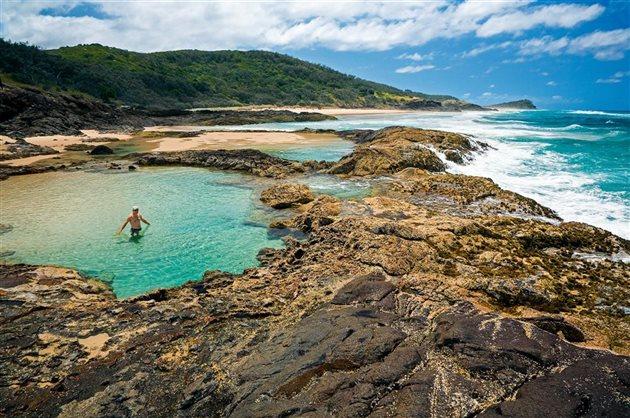
My favourite place in South Australia: Kangaroo Island
Have you heard of Kangaroo Island? No? To be honest, I didn't know anything about the island in South Australia until shortly before my trip to Australia. The "kangaroo island" Kangaroo Island is not only the third largest island in Australia, it is also a paradise for animal and nature lovers. It's like a big zoo without fences, because the variety of animals is unique.
There are so many magical places in Australia that I could visit during my 3-month road trip. But Kangaroo Island is one of the special highlights in Australia. Koalas, kangaroos, seals, sea lions, echidnas and impressive rock formations make a visit to this island a unique experience.
Locals' eyes light up when I show them around in Adelaide about our upcoming 2-day trip to Kangaroo Island . Their "KI" (keei aiii), as they affectionately call Kangaroo Island. No wonder our expectations are high as we board the ferry to Kangaroo Island.
My first kangaroos in the wild
Early in the morning we wait at the agreed meeting point for the bus to the ferry to collect us. After a 2-hour drive we arrive at the Cape Jarvis Ferry Terminal via the Fleurieu Peninsula. Already during the ride we see the first kangaroos. The first ever for me in the wild! I am delighted and immediately wide awake.
Either boxing (yes they really do it), lying chilled in the grass or standing upright watching us. I don't know at this point that many live kangaroos are a rarity. Many travellers see more dead kangaroos than live ones. For me, fortunately, the balance is positive.
The journey to Kangaroo Island
We have a little time before the ferry leaves and treat ourselves to a first Flat White in the terminal. The ferry departs punctually at 9 am. The swell makes the colour drain from many a passenger's face. I, on the other hand, love swells and am glad that I have never had to struggle with seasickness. An hour later we dock.
Our guide Pierre from Kangaroo Island Odysseys is already waiting at the terminal in Penneshaw. We will spend the next two days exploring the island with him. First, he explains to us on the basis of a large map which places we will visit in the next 48 hours.
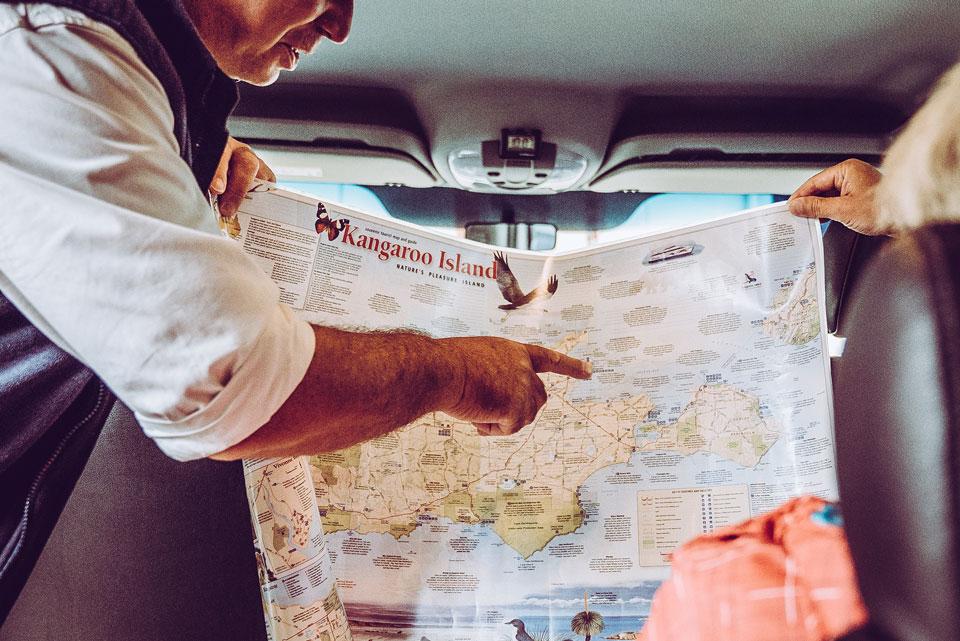
Pierre from Kangaroo Island Odyssey explains the schedule for the next two days.
We set off and experience 48 hours that I won't forget in a hurry. Kangaroo Island has reserved a place in my heart forever. And who knows, maybe I'll go to the little kangaroo island again at the end of my 3-month trip to Australia? I have a great desire to do so ...
Highlights on Kangaroo Island
Pennington Bay
Our first stop of the tour is the beautiful beach of Pennington Bay. The bay is located on the south coast and offers one of the best surf spots on the island. This wide bay is less suitable for swimmers as there are often undercurrents, making swimming a dangerous experience.
Dolphins and whales can probably also be observed here. Unfortunately, I am here outside the whale season. Dolphins are also not yet visible in the morning.
 Pennington Bay, Kangaroo Island
 Pennington Bay on Kangaroo Island is the first unspoilt beach we visit.
Already on the way there we meet the Kangagroo Island kangaroos, which are chocolate brown and smaller than the kangaroos on the mainland. Pierre is also very particular about the fact that these kangaroos do not box.

Kangaroos on Kangaroo Island are chocolate brown and smaller than their counterparts on the mainland.
Koalas at the Eleanor River
The best part of the tour with Kangaroo Island Odyssey follows now. We drive to a private property on the Eleanor River. After an extensive lunch with wine, we go in search of koalas. But we don't really have to look for them. In almost every tree we find at least one - in another even six koalas spread out.
It's like a game, and so we search together, because the koalas are sometimes really well camouflaged. The tour was worth it just for this place. I am in love with these cute little animals.
 If you know how to find koalas, it's really not difficult to spot the cute animals in the eucalyptus trees on Kangaroo Island.
 ...and another koala bear. Our record was 6 koalas in one den. Guide Pierre's is 12 (!!!).
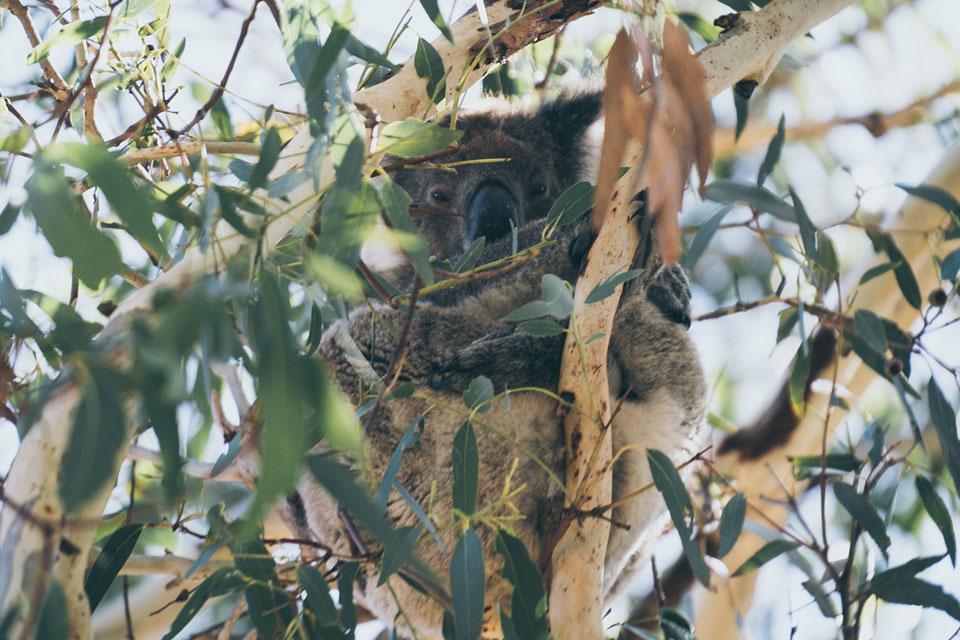 ... and another "tree hugger" as koalas are affectionately called.
Seal Bay
I am still blown away by the koalas when we reach the next highlight: Seal Bay. Seal Bay is the only place in the world where you can get so close to Australian sea lions. It is also the largest colony of these rare animals.
We get very close to the animals. But we keep enough distance. Not only for animal welfare reasons, but also because the animals can become quite aggressive.
During our visit, the animals are quite unimpressed by us. The sea lions lie around dozing. An alpha male shows his power and chases away every other male that comes too close to him. Afterwards he gets kisses from the female sea lions. We have a good time. Young animals playfully chase seagulls. Cute as sugar and no less fascinating than kangaroos or koalas.
More info on Seal Bay:
Seal Bay is about 45 minutes by car from Kingscote.
Visits on your own via the Boardwalk are possible from 9 am - 4.15 pm.
A tour (duration approx. 45 minutes) directly to the beach to see the sea lions is only possible with a guide. Tours run daily every 45 minutes. For detailed information you should check the website of the South Australian National Parks.
Admission with guided tour, boardwalk and lookout is 35 AUD for adults and 20 AUD for children.
Bay of Shoals (Emu Bay)
At the end of the day we drive to the Bay of Shoals (Emu Bay) to watch the Australian spectacled pelicans catching fish. Here they wait for the fish scraps from the fishermen and grab as much food as possible.
The beach is particularly popular with Australians because it is one of only two beaches on Kangaroo Island that can also be driven on with a four-wheel drive vehicle. I still don't understand why you absolutely have to do this, but the beach is really beautiful. When we visited, it was rather autumnal and cool. Therefore, the beach was deserted shortly before sunset.
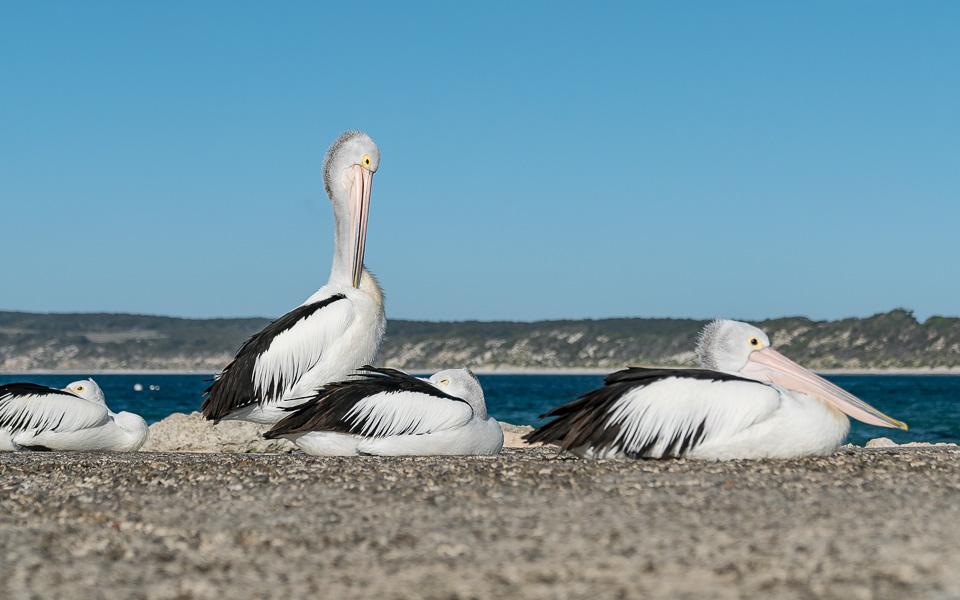

Stokes Bay
"Stokey Bay is magic," Pierre raves to us. On the drive from Kingscote via Reeves Point, we spot a wallaby on the side of the road and see two Wedge Tailed Eagles and a large flock of Crimson Rosella birds. Pink-white-black birds that make an animalistic noise but provide a great splash of colour in the landscape.
When we arrive, I don't know what Pierre is talking about at first. The car park and the rocks with the sea look beautiful, but not "magical". But he grins and leads us through a maze of narrow rocks. We squeeze through narrow passages between the rocks until we suddenly come out directly on a hidden beach.
It is dreamlike. Bright orange starfish lie in the shallow water and apart from us there are no other people on the beach. Nature at its best! For all the beauty we forgot to take a picture or two - sorry!


Snelling Beach
At Snelling Beach we stop at a viewpoint and enjoy the view of the bay. The beach is one of the most popular on the north coast of KI. Unfortunately, we don't have time to drive down to the beach. The best view is from the lookout on the road passing by above, down into the valley.

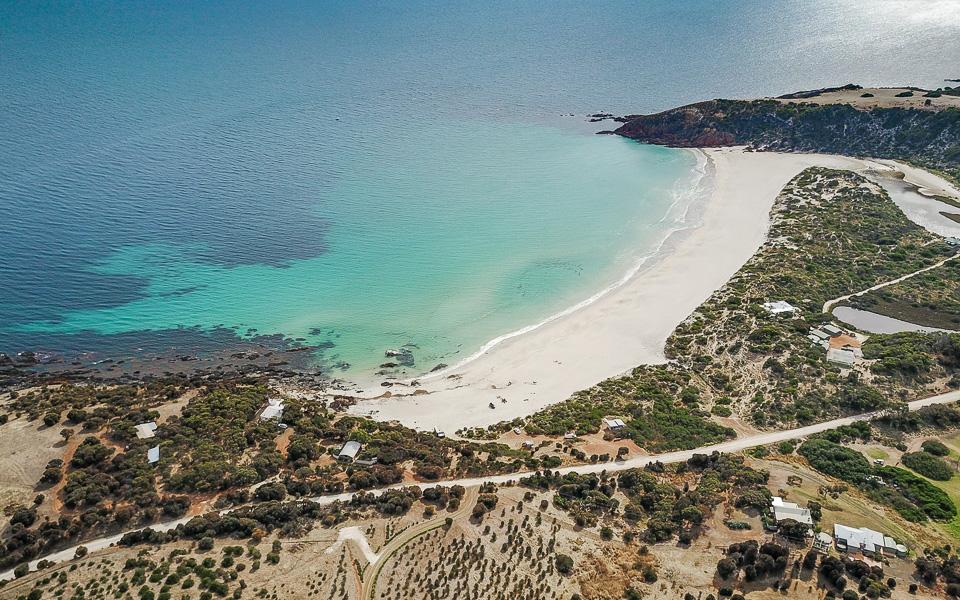
Snelling Beach, drone shot
Flinders Chase National Park
Flinders Chase National Park is one of the highlights on Kangaroo Island. Every tourist comes here to the West End. Dense forests, untouched nature, white sandy beaches and striking rock formations await us here.
Even at the car park at the Visitors Centre, you should take a closer look upwards, because here you can observe koalas wonderfully.

You also have a good chance of spotting wallabies here, because unfortunately the animals seem to have been fed here quite often, especially in the picnic area, or have filled their stomachs with leftovers from visitors ...

A wallaby that had probably been fed several times and didn't look too healthy. Unfortunately.
At the Visitors Centre, hiking trails branch off into the forest. We only have a short time, but walk a few metres anyway. Here, too, we are lucky to see koalas in the trees.
Information about Flinders Chase National Park:
The visitor centre is open daily from 9am - 5pm. Outside opening hours it is possible to register yourself.
Day pass: 11 AUD adults, 9 AUD children and 2-day pass: 16 AUD adults and 10 AUD children.
Remarkable Rocks
The "Remarkable Rocks" in Flinders Chase National Park are Australia's fourth landmark and Kangaroo Island's most famous rock formation. So I'm not surprised that many tourists stop here in particular.
From a distance, the formation looks quite unspectacular, as the road with along the rugged cliffs is more photogenic. But the closer you get, the more unusual the rocks look.

The impressive granite boulders have been exposed to wind and weather over thousands of years and thus formed. Some are hollowed out on the inside, on others an undulating surface has formed.
The elevation on which the Remarkable Rocks are located rises 75 metres from the sea. Depending on the light and sunlight, the rocks glow red, orange or not at all.


Admirals Arch and Cape du Couedic
At the windy Cape du Couedic, the Admirals Arch is another highlight of the Flinders Chase National Park. New Zealand fur seals live here under protection. Rough rocks and turquoise water make the panorama perfect.

Hard to see in the picture: But the small dots on the rocks are the New Zealand fur seals.
Even zoomed in, the seals on these mighty rocks are only visible as small dots:


At the famous Admirals Arch we are lucky and a seal places itself in front of us on a rock:

Admirals Arch and its seals are a highlight in Flinders Chase National Park
Vivonne Bay - the best comes at the end
One last highlight awaits us at Vivonne Bay. The long and wide bay has even been voted one of the world's 10 most beautiful and unspoilt beaches. I am not surprised about that.
Unfortunately, it is time to say goodbye to this beautiful island. One thing I know for sure: I will be back!

Vivonne Bay, one of the most beautiful unspoilt beaches in the world 
Wallabies, kangaroos and winding roads
Most roads to national parks and beaches are tarred. However, thanks to our four-wheel drive vehicle, we often take shortcuts over bumpy unsealed roads. No matter where we drive - the roads are a feast for the eyes and a highlight in themselves.
Road signs warn of kangaroos. Again and again we see dead wallabies and kangaroos lying on the side of the road. "Roadkill" as these carcasses are called here. Unfortunately, the only way to avoid these crashes is to stop driving after dark. It is not always avoidable.
But the good thing about Kangaroo Island is that you see more live animals than dead ones.

Tammar Wallabies - Kangaroos in miniature
Like tammar wallabies, for example, which are already extinct on the mainland. These small kangaroos are darker and smaller than their relatives on the mainland. The easiest place to find them is in Flinders Chase National Park. We have already spotted them along the road to the park. This was not difficult as they were busy feeding in the shade of the trees.
 A little wallabie - aren't they cute?
 Wallabie Kangaroo Island
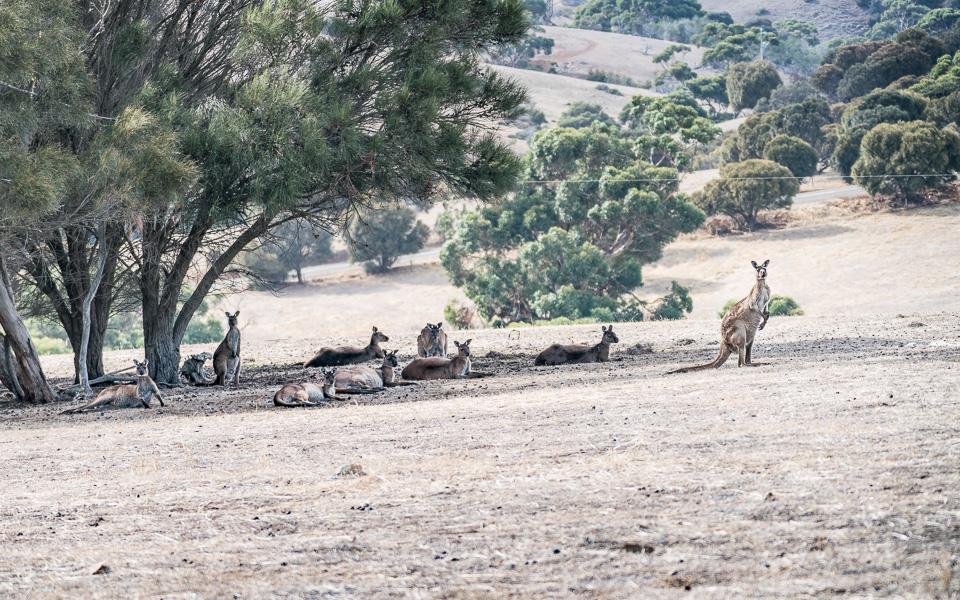 Kangaroos - relaxed and numerous on Kangaroo Island
 Tammar Wallaby - a kangaroo in miniature, so to speak.
As we caught a cooler and slightly rainy day, especially on the first day on Kangaroo Island, we could see kangaroos along the roads all day. Most of the time they lay relaxed under trees in the shade (if the sun was visible for a short time) or watched us curiously from a distance.


The winding roads on Kangaroo Island
No matter where you were on Kangaroo Island. Every road was special. Here are a few impressions of what to expect:
 Beautiful avenue of eucalyptus trees on Kangaroo Island.
 You know this winding road from various social media channels. It's even better and more beautiful live!
Map of Kangaroo Island:
I have numbered our route and highlights on this map of Kangaroo Island.
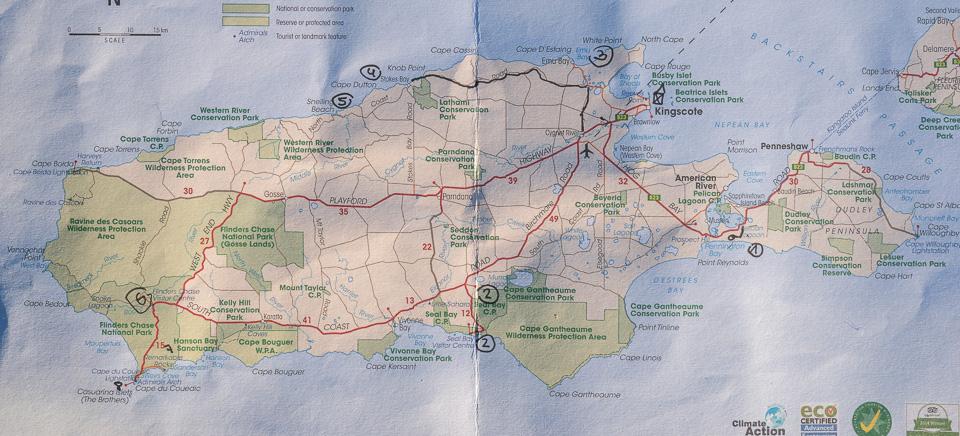
Map of Kangaroo Island More travel tips & info
Facts & figures about Kangaroo Island
One third of the 155 km long island consists of national parks and is surprisingly diverse: steep cliffs, densely forested national parks, towering sand dunes, wetlands and pristine white sand beaches. Impressively, more than half of the island's original vegetation is still intact thanks to sustainable tourism and programmes to protect flora and fauna.
Only 4,600 people live here - mainly from agriculture and also from tourism. No wonder, then, that products come from here that are among the best in the country. Goat cheese, honey, one of Australia's best gins and fine wines all come from this small island. By the way, you can buy many of the products at Adelaide's Central Market.
We booked this two-day trip with an overnight stay at Kangaroo Island Odyssey. I advise you to stay between 3 - 7 days on the island if possible. Not because there is so much to see, but just to soak up and experience this special atmosphere of the island. I would have liked to stay longer, but unfortunately didn't have more time.
Visit Kangaroo Island on your own?
Before a trip, you always ask yourself whether you want to discover a place individually or as part of a tour. For us it was quite simple: We didn't have a rental car at the beginning of our trip along the south coast to Perth. In addition, almost all rental car companies state in the small print that you are not allowed to drive to "KI" with the rental car.
We therefore booked a "2 Day Highlights of Kangaroo Island Tour" from Adelaide. The excursion into nature is not cheap. But if you add up all the costs separately, it is worth booking a tour if you don't want to spend at least five days on Kangaroo Island.
The ferry ticket alone would cost us AUD 98 there and back. With a car or campervan, an additional 196 AUD. Accommodation and prices in restaurants cost more than on the mainland. But the standard is really not that high. Entrance fees to the national parks are also a little more expensive here. You would have to pay separately for each place.
In the end, the 1144 AUD (approx. 760 euros) is money well spent and I am glad to have made this trip. The group is very small (8 in total) and we get to places that are privately owned. Other operators can't get there. Exactly at this place there are koalas. Not just one or two, but up to six in one tree. Many more scattered among the eucalyptus trees, the cuddly animals chill high up.
How to get there: How to get to Kangaroo Island
By ferry and bus from Adelaide
Take the SeaLink ferry for cars and passengers from Cape Jarvis to Penneshaw. The crossing takes about 45 minutes to 1 hour. The swell can be heavy or non-existent. For us, the outward and return journeys were not comparable.
The ferry takes passengers from the mainland to Kangaroo Island and back eight times a day (except at Christmas). The journey to Cape Jarvis from Adelaide takes about 2 hours. You should book a trip in advance to make sure you are still allowed on.
If you book a tour with Kangaroo Island Odyssey like I did, the transfer from Adelaide by bus and back is included.
By plane
From Adelaide you can get to Kingsote Airport in 30 minutes by plane. There are four return flights daily.
By car
If you want to drive to Kangaroo Island by rental car, you have to make sure that your rental car company also allows you to drive to Kangaroo Island. I read in the run-up to the trip that driving on Kangaroo Island is prohibited.
If you want to rent a car locally, there are limited options for 2WD and 4WD (I would recommend for the dirt roads). The main roads are tarred but the roads to the most interesting highlights are gravel and dirt roads.
Packages for ferry, car and campsites are offered by Sealink.
Accommodation on Kangaroo Island
There are a few hotels in Kingscote. We stayed at the Aurora Ozone Hotel in Kingscote. The room was large and had a sea view. As the number of accommodations is very limited, you should book well in advance. We booked through Kangaroo Island Odyssey, who gave us a full package from Adelaide.
If you like luxury, you should check out the Southern Ocean Lodge (update: unfortunately burnt down). It is one of the most beautiful accommodations in Australia and is located on a cliff at Hanson Bay.
There are also many unique places to stay on Kangaroo Island, such as Cape du Couedic Lighthouse or Cape Borda Lighthouse. You can book accommodation here.
Entrance fees for Kangaroo Island
Kangaroo Island Pass
For visitors who have not booked a tour there is the Kangaroo Island Pass. This pass gives you access for 12 months to the following places and attractions:
Seal Bay guided tour, boardwalk and lookout.
Kelly Hill show cave tour (I didn't go and can't say if it's worth it)
Flinders Chase National Park, Cape Borda Lighthouse Tour, Cape Willoughby Lighthouse Tour (we did not do either lighthouse tour).
The pass costs AUD 70 for adults and AUD 43 for children (as of March 2017).
You can also pay separate entrance fees for all of these highlights.
Everything else you need to know about Kangaroo Island
There are ATMs in Kingscote, Penneshaw, Parndana, American River and at the Flinders Chase Visitors Centre.
There are few restaurants in Kingscote that close very early (I didn't go to the other places in the evening). We preferred to dine at the hotel restaurant. The portions were large, the prices fair.
Kangaroo Island Wilderness Trail
The Kangaroo Island Wilderness Trail is a five-day hike (4 nights). The trail is still relatively new but already very popular. We met a few smaller hiking groups on the way.
Best time to visit Kangaroo Island
The temperatures on Kangaroo Island are always quite mild due to its location by the sea. In summer, however, it can be over 40 degrees. Then it is unbearably hot that even the koalas climb down from the trees and hang on the lower end of the tree trunk to cool down.
I was on Kangaroo Island at the beginning of autumn in mid/late March. During the day it was pleasant with temperatures around 24° degrees. As soon as the sun was there, it was hot. However, on one day we had relatively bad weather. Short but light drizzle and a cloudy sky. On the other hand, it was not too hot for the many animals, so that kangaroos and wallabies were also quite active during the day.
Have you already been to Kangaroo Island? If you have any other tips, I'd love to hear from you at the end of this article. Also, if you have any questions, feel free to leave them in the comments!